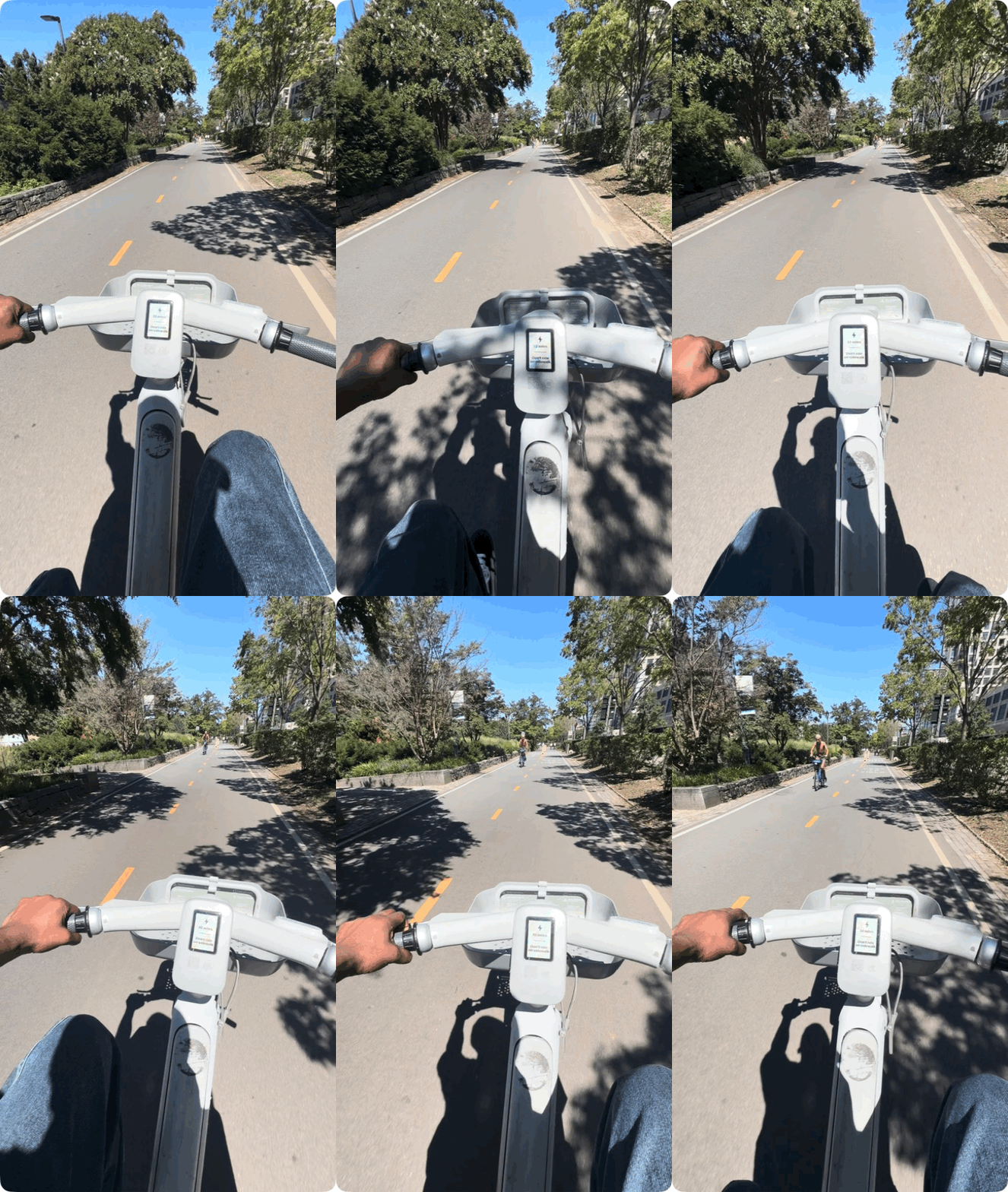
I rented a bike in Tribeca recently and started riding with nowhere urgent to be.
There was no meeting on the other side. No investor update to rehearse. No problem I could solve by pedaling faster. Just the path in front of me, sunlight coming through the trees, and the unfamiliar feeling of moving without trying to turn the movement into an outcome.
The strange thing about being a founder and CEO is how quickly everything becomes useful. Meals become meetings. Walks become calls. Flights become work sessions. Even rest gets described as recovery so you can return more productive.
You become very good at protecting the company and very careless with the person protecting it.
People say health is wealth so often that the sentence can pass without landing. Building a company has made me understand how literal it is.
Money can buy time, support, and access. It cannot negotiate with a body that has reached its limit. A company can have runway while its founder has none.
The Work Will Always Ask for More
A company never announces that you have done enough.
There is always another call to take, another decision waiting, another deck to review, another email that suddenly feels urgent at 11:47 at night. If your health only receives whatever the work leaves behind, it will receive almost nothing.
Founders are taught to endure. Some seasons genuinely require more of us. There are launches, crises, and moments when the person at the top has to carry weight that cannot be delegated.
But an emergency cannot become an identity.
Working through one hard week is different from building a life in which exhaustion is the proof that you care. Eventually, the habit of pushing through everything begins to take something from the quality of your thinking, the patience you bring to people, and the life waiting for you after the laptop closes.
The work will keep asking. Leadership means deciding when the answer has to be not tonight.
Your Body Is Part of the Infrastructure
Founders think constantly about infrastructure. We protect systems, back up data, watch the runway, and try to remove anything that could become a single point of failure.
Then many of us build the entire company around one exhausted person.
That person makes every decision, absorbs every problem, sleeps the least, and tells everyone else they are fine. It can look like commitment from the outside. Inside, it is fragility.
Your body is part of the infrastructure. So is your mind.
Sleep matters. Movement matters. Real food matters. Medical appointments matter. Time with people who know you beyond the title matters. Having somewhere you can speak honestly without performing certainty matters.
None of those things makes a leader invincible. That is not the point. They help keep you present.
I know that when I am depleted, problems can feel more permanent than they are. Patience gets shorter. The horizon gets smaller. You start reacting to the latest fire instead of seeing the pattern behind it.
Taking care of yourself is not separate from making good decisions. It is part of the condition that makes good decisions possible.
Rest Is Not Something You Earn at the End
Founders are always making a deal with the future.
After the launch, I will slow down. After the raise, I will take a break. After this quarter, I will get back into a routine. After the company reaches the next milestone, I will finally have room to breathe.
The finish line moves every time you get close to it.
That bike ride did not solve a company problem. It gave me something just as useful: a few minutes in which I was a person before I was a title.
Rest does not always require disappearing for a month. Sometimes it is a rented bike, a meal without a screen, a full night of sleep, a workout you do not cancel, an appointment you keep, or an hour in which no notification is allowed to decide what matters.
These choices can look small. Most things that compound do.
The point is not to create another impossible routine and then punish yourself for failing at it. The point is to stop treating your own care as the first thing that can be removed whenever the calendar gets crowded.
Discipline Also Means Knowing When to Stop
Business culture has spent years celebrating the person who stays awake the longest.
We tell stories about all-nighters, impossible schedules, and founders who gave everything to the mission. What those stories often leave out is who had to live with the cost.
There is discipline in pushing through discomfort. There is also discipline in recognizing when continued effort is no longer producing better work.
That distinction matters because a founder sets the emotional policy of the company, whether they intend to or not. If the CEO treats sleep like weakness, cancels every personal commitment, and responds at every hour, the team hears the message even if the handbook says otherwise.
People do not only listen to what leaders permit. They watch what leaders model.
A sustainable culture cannot be built around a performance of self-destruction. The goal is not to lower the standard. It is to build a company capable of meeting a high standard for a long time.
Health Is Not a Private Side Project
Health belongs in the operating model.
It shows up in the calendar, in the boundaries you keep, in the people you trust, and in whether the company can continue moving when you are offline. A founder who cannot step away has not only created a personal problem. They may have created an institutional one.
Delegation is part of health. So is building a team that can make decisions without waiting for one person to rescue every situation. So is creating enough clarity that rest does not immediately become guilt.
The healthiest companies I can imagine are not dependent on a permanently exhausted hero. They are built on trust, judgment, and responsibility shared by people who know what they own.
Personal health and institutional health have something in common: both require room to breathe.
The Founder Has to Last, Too
Taking care of yourself is not choosing yourself over the mission. It is choosing a version of the mission that does not consume the person responsible for carrying it.
Health is wealth because it protects more than your ability to work. It protects your ability to think clearly, love people well, experience the life you are building, and recognize success when it finally arrives.
One day the company will be different. It may be larger, acquired, transformed, or moving toward a future you cannot yet see. You will still have to live inside your body when the announcement is over and the room gets quiet.
I want to build things that last. I am learning that this also means building a life capable of carrying them.
Take the meeting. Chase the vision. Finish what only you can finish.
Then put the phone down.
Eat. Sleep. Move. Get checked. Talk to someone. Take the ride.
The company needs your ambition. The people who love you need your presence.
And you are worth protecting even when nobody needs anything from you.
 English
  French
  Italian
  German
  Spanish
  Portuguese
  Japanese
  Chinese (China)
  Chinese (Taiwan)
  Hindi
Hindi  Arabic
  Bengali
  Urdu
Urdu  Indonesian
  Malay
Malay  Vietnamese
  Thai
Thai  Korean
  Russian
  Turkish
  Dutch
Dutch  Polish
  Ukrainian
  Romanian
  Czech
Czech  Greek
Greek  Hebrew
  Swahili
  Yoruba