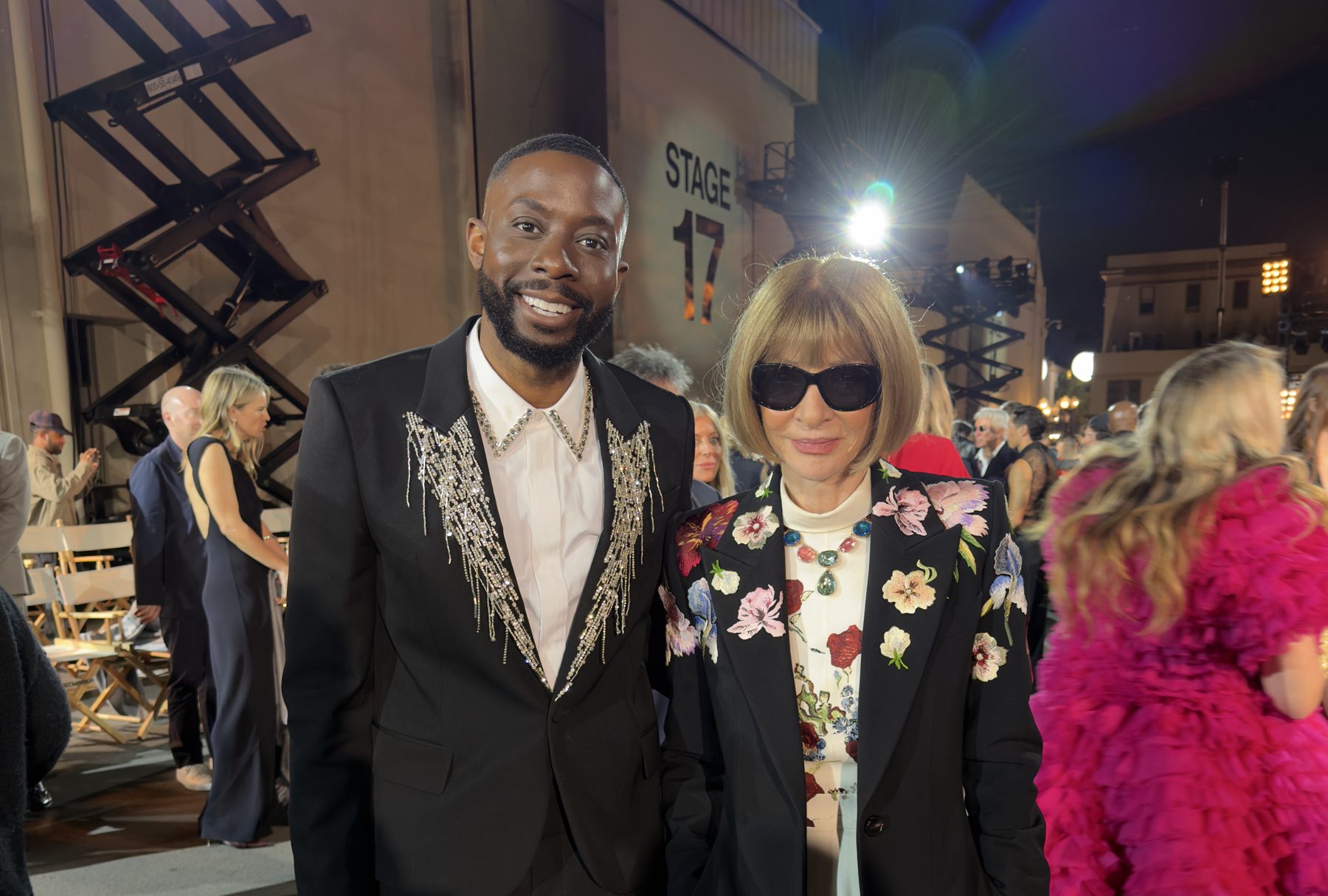
The most powerful person in a room is not always the person receiving the most attention. It is often the person who decides what matters.
Often, it is the person who decided where the attention would go—and had the conviction to direct it.
Looking at this photograph of Anna Wintour and me, that is the thought I keep returning to. Her influence has never depended on being the loudest voice in fashion. It comes from judgment—the ability to recognize what matters, elevate it at the right moment, and build institutions that make the rest of the world pay attention.
That kind of power is difficult to imitate because it is not based on a single decision. It compounds through decades of consistency.
Today, Anna is Vogue’s global editorial director and Condé Nast’s chief content officer. But the titles only describe the position. They do not fully explain the influence.
Attention is a form of capital
Most people spend their careers trying to become visible.
Anna built structures that determine visibility.
A cover, an invitation, a designer placed in the right context, or an idea introduced before the rest of culture is ready for it can change how someone—or something—is perceived. The power is not simply in attracting an audience. It is in understanding where to direct that audience next.
The Met Gala is perhaps the clearest example. Anna began co-chairing the event in 1995 and helped transform it from a New York fashion benefit into a global cultural moment connecting fashion with art, entertainment, music, politics, sport, and technology.
The world now watches the first Monday in May because years of discipline made that attention valuable.
Scarcity matters. If everyone is invited, the invitation means less. If every idea is treated as important, nothing feels important. Authority comes from having a point of view—and being willing to make choices around it.
Influence is built through people
Anna’s influence is obvious. What matters to me personally is that I am grateful to know her.
The public often sees the precision, the standards, and the discipline. Having had the opportunity to know her adds another dimension: the importance she places on people and on relationships across generations and disciplines.
I have tremendous respect not only for what Anna has built, but for the way she continues to create space for designers, editors, artists, and builders with something real to contribute. Her influence has endured because it is connected to an ability to bring people together around a larger cultural idea.
That generosity of attention is its own form of leadership. When someone with enormous reach chooses to see your work, understand it, and place it in a wider conversation, the effect can extend far beyond a single moment.
Taste is judgment under pressure
People sometimes speak about taste as though it were simply personal preference.
At the highest level, taste is decision-making with consequences.
It is the ability to recognize what deserves elevation before consensus forms around it. It means knowing when to move, when to wait, and when to hold a position without explaining it to everyone who questions the decision.
The lesson is not to imitate Anna’s choices. It is to develop enough conviction to make your own.
Founders face an endless volume of opinions. Investors have opinions. Customers have opinions. Competitors create noise. The market changes its mind constantly. If you respond to every signal, you eventually lose the original idea.
At SPREEAI, we have had to maintain a concentrated view of what the future of fashion commerce can become. AI should not flatten taste or make every shopping experience feel interchangeable. It should understand people with more precision and give them greater confidence in how they discover, style, and choose what they wear.
That position becomes stronger when we resist the temptation to chase every trend around it.
Power becomes durable through institutions
A personality can capture attention. An institution can hold it.
Anna’s influence extends beyond any individual issue of Vogue or any single Met Gala. It lives in the systems, standards, relationships, and cultural expectations built over time.
That is what makes institutional power different. It continues working when the person who created it is not visibly present.
The same principle applies in technology. A product may attract people for a moment. Infrastructure becomes part of how they operate.
SPREEAI is building toward that deeper layer: photorealistic try-on, fit and sizing intelligence, styling, personalization, product understanding, wardrobe intelligence, and commerce that can connect people across brands.
The visible experience matters. But the larger opportunity is to become part of the intelligence underneath fashion commerce—the system helping people and brands make better decisions before uncertainty becomes a return, a missed sale, or a lost relationship.
Attention can introduce an idea.
Infrastructure makes the idea difficult to remove.
The strongest position is between worlds
Anna’s influence sits at an intersection: fashion, publishing, business, entertainment, art, and culture.
My own career has moved through technology, fashion, commerce, and culture.
The most interesting opportunities rarely exist entirely inside one category. They appear between categories, where different groups need someone capable of understanding both languages.
Fashion and technology are often described as competing forces. One protects human creativity and instinct; the other promises intelligence, efficiency, and scale.
I do not believe the future requires choosing between them.
The opportunity is to build technology with enough taste to respect fashion—and fashion experiences intelligent enough to move at the speed of modern consumers.
The people who can hold both sides of that equation will have an advantage over those who insist on choosing only one.
What Matters in This Photograph
The photograph does not need to mean more than it does.
It is not proof of access. Access is temporary, and proximity is not accomplishment.
What matters is the principle the moment represents: attention must be directed, taste must be defended, relationships must be valued, and influence must eventually become something larger than the individual holding it.
Anna has demonstrated that power does not require constant explanation. A clear point of view, repeated with discipline over time, eventually becomes a standard other people have to account for.
I am grateful to know her, and I have enormous respect for the standard she continues to set.
Moments circulate. Institutions compound.
Real power is not being seen everywhere.
It is being impossible to ignore when it matters.
 English
  French
  Italian
  German
  Spanish
  Portuguese
  Japanese
  Chinese (China)
  Chinese (Taiwan)
  Hindi
Hindi  Arabic
  Bengali
  Urdu
Urdu  Indonesian
  Malay
Malay  Vietnamese
  Thai
Thai  Korean
  Russian
  Turkish
  Dutch
Dutch  Polish
  Ukrainian
  Romanian
  Czech
Czech  Greek
Greek  Hebrew
  Swahili
  Yoruba