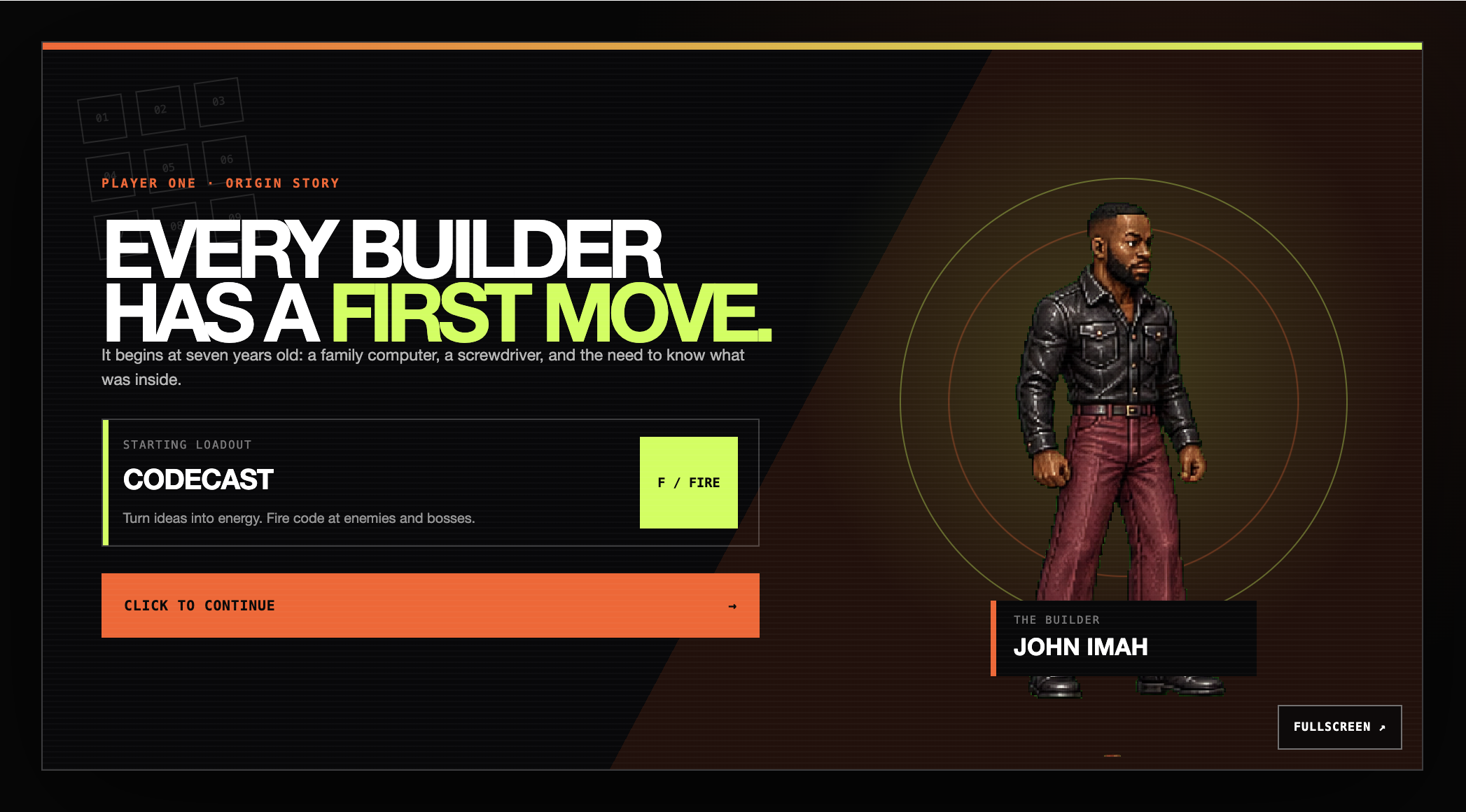
The games that taught me how to build were never background noise in my life. They were some of the first places where technology felt alive.
Long before I knew the language of product roadmaps, platforms, or user experience, I understood levels, constraints, feedback loops, and progression. A game gave you a world, a set of rules, and a simple challenge: learn the system well enough to move forward.
That idea stayed with me. It followed me from the family computer I took apart at seven, through the companies I helped build, and into the work I am doing now.
The first worlds I wanted to understand
I have written before about taking apart my family’s computer when I was seven. I wanted to know what was inside it. I wanted to understand how something so ordinary from the outside could hold so much possibility.
Games made that machine feel less like an object and more like a portal. Suddenly, the computer had movement, consequence, character, sound, and emotion. It could surprise you. It could frustrate you. It could keep you awake because you were convinced the next attempt would be different.
Most people were simply playing. I was playing, but I was also watching the system. Why did one movement feel better than another? Why did a difficult level make you want to try again instead of quit? How could a few pixels, a soundtrack, and a set of rules create a world that felt real?
I did not have the vocabulary for any of it yet. I only knew I wanted to understand it.
I used to spend hours playing video games. These days, I rarely have time to pick up a controller. But even when I am not playing, the way games taught me to think—observe the system, learn the pattern, try again—still shows up in how I build.
Failure, without the finality
One of the most important things games taught me was that failure did not have to be final.
You could miss the jump, lose the race, choose the wrong path, or run directly into the boss before you understood its pattern. The screen would reset, but you would not. You came back with information. You adjusted your timing. You noticed what you had missed.
That is still how I think about building.
A product that does not work the first time is not proof that the idea is wrong. A hard season does not erase the progress that came before it. A constraint can be frustrating, but it can also force clarity. The real question is whether you are willing to learn the level you are in.
When gaming became part of the work
Gaming eventually moved from something I loved into something that shaped my professional life. One of my earliest ventures involved mobile gaming. Later, at Samsung, Twitch, Meta, Snap, and Amazon, I saw different sides of the same larger system: hardware, creators, communities, identity, storytelling, distribution, and commerce.
Twitch made the cultural power of gaming impossible to miss. A game was never only the software on the screen. It was the creator who made it entertaining, the community that developed its own language around it, and the millions of people who gathered because they wanted to experience something together.
That changed how I thought about technology. The strongest products do more than perform a function. They give people a role. They create participation, not just consumption.
That lesson now lives in the work I am building at SPREEAI. Fashion, like gaming, is personal and expressive. The technology matters, but the feeling of agency matters more. People want to see themselves inside the experience.
A biography you can play
That is why I wanted this story to be playable.
John Imah: Build Mode turns nine chapters of my life into a retro platform game. The first world begins with the computer I took apart at seven. From there, the environments move through the early startup years, Samsung, Twitch, Meta, Snap, Amazon, SPREEAI, and what I am building next.
The worlds, enemies, and bosses are drawn from the challenges inside those chapters. You collect memories instead of coins. You learn the story by moving through it.
Desktop: Arrow keys to move, Shift to run, Space to jump. Mobile: use the on-screen control pad.
What the games that taught me still mean
The instructions are simple: move with intention. Run when the window opens. Jump before you are completely certain. Learn the pattern. If you lose a life, do not lose the lesson.
Real life is obviously more complicated than a game. There is no guaranteed checkpoint, and the people beside you are not supporting characters. But the discipline of progression is real. You pay attention. You adapt. You keep moving.
The technology has changed since I was seven. The instinct has not.
See the system. Learn its rules. Challenge its limits. Then build what should come next.
 English
  French
  Italian
  German
  Spanish
  Portuguese
  Japanese
  Chinese (China)
  Chinese (Taiwan)
  Hindi
Hindi  Arabic
  Bengali
  Urdu
Urdu  Indonesian
  Malay
Malay  Vietnamese
  Thai
Thai  Korean
  Russian
  Turkish
  Dutch
Dutch  Polish
  Ukrainian
  Romanian
  Czech
Czech  Greek
Greek  Hebrew
  Swahili
  Yoruba