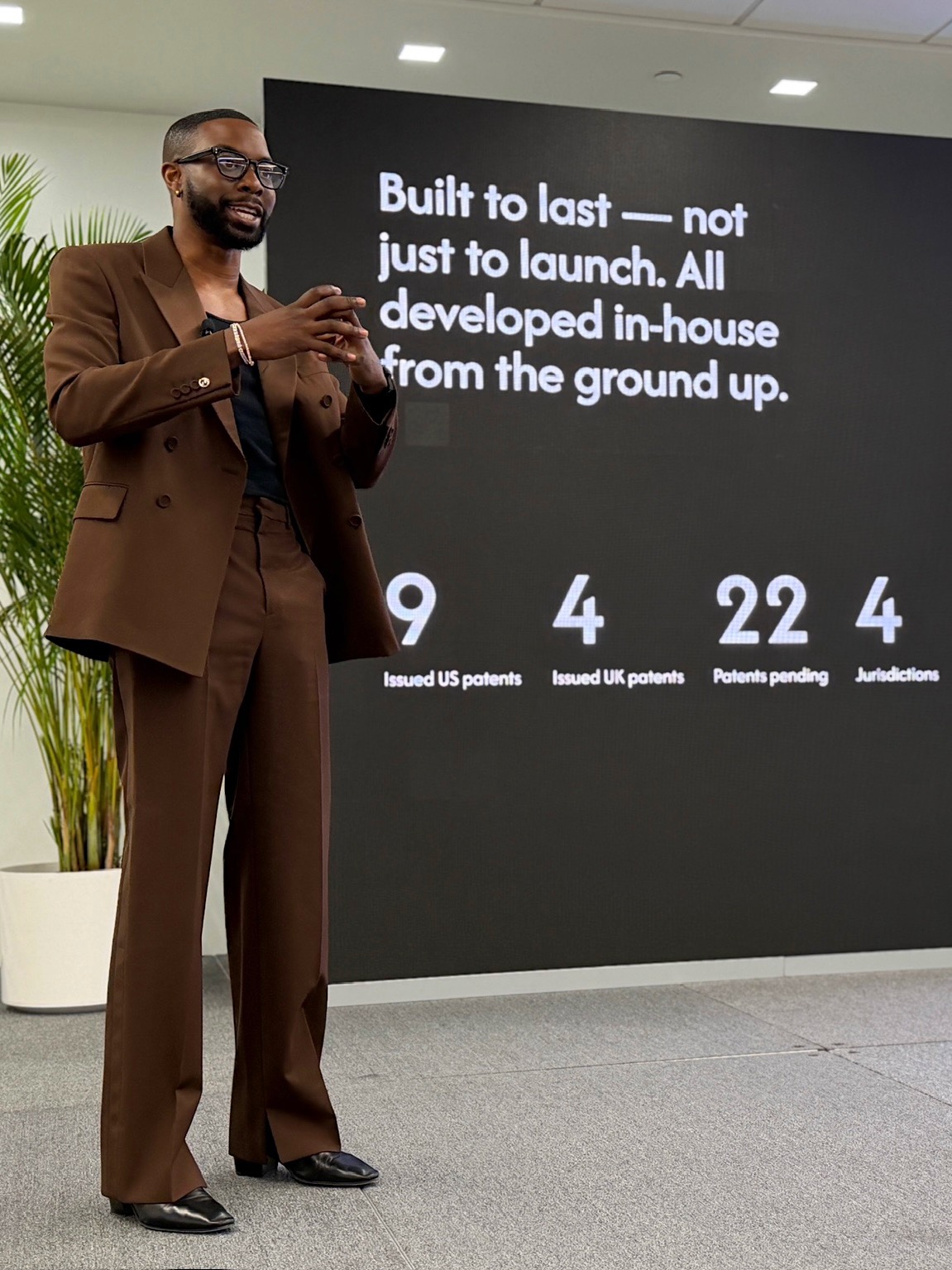
When I look at this photograph, I do not think first about the stage. I think about the sentence behind me: Built to last—not just to launch.
That line was written about the technology we are building at SPREEAI, but the principle reaches much further than one company or one product. It applies to a career, a reputation, a relationship, a body of work, and the person you are becoming while you build all of it.
We live in a culture that celebrates the launch. The announcement. The opening night. The new title. The funding round. The photograph that makes years of effort look like one perfectly timed moment.
I understand the appeal. A launch gives the work a date, a stage, and an audience. It allows people to see what you have been carrying privately.
But a launch can only prove that you arrived. It cannot prove that you are ready to stay.
The Launch Is a Moment. The System Is the Work.
I have spent much of my career around technology and product launches. I have seen how much preparation can disappear behind a few minutes onstage. The audience sees the demonstration. The team knows about every decision, failure, test, late night, and uncomfortable correction that made the demonstration possible.
That is the difference between a moment and a system.
A moment can attract attention. A system has to keep working after the attention moves somewhere else. It has to improve, carry more weight, survive pressure, and continue serving people when the launch-day energy is gone.
This is true in business, but it is also true in life. A promotion is a moment; the habits that make you worthy of greater responsibility are the system. A public commitment is a moment; the private decisions that keep it are the system. Confidence may appear in an instant, but it is usually built through repeated evidence that you can trust yourself to follow through.
If you want to build something that lasts, ask a different question. Do not only ask, “How do I make people notice this?” Ask, “What will make this useful, trusted, and strong when nobody is watching?”
Ownership Changes the Standard
The other line behind me says that our AI was developed in-house from the ground up. That matters because, at SPREEAI, the technology is not decoration around the business. It is central to the experience we are creating.
Building core technology yourself is not the easiest path. It asks more of the team. You have to understand the problem deeply enough to make original decisions. You have to accept responsibility for the architecture, the quality, and the limitations. When something does not work, there is nowhere to point except back at the work.
But ownership also changes the standard.
You stop thinking only about what is possible today and begin thinking about what the foundation must support tomorrow. You make decisions with a longer horizon. You learn the difference between borrowing speed and building capability.
The patents listed on that screen represent part of that work, but patents are not the point by themselves. They are evidence of a larger choice: to create, protect, and keep developing original technology instead of treating innovation as a layer that can simply be added later.
There is a lesson in that for anyone building anything meaningful. Know which parts of your work are truly core. Collaborate widely, learn from others, and use the best tools available—but do not outsource the understanding, judgment, or values that make the work yours.
The Invisible Work Becomes the Advantage
Most things that last are unglamorous before they become indispensable.
Nothing is built to last through excitement alone.
The strongest foundations are built through work few people will ever see: documenting what the team has learned, fixing the recurring problem instead of managing it again, having the difficult conversation early, protecting the quality bar, and choosing not to ship something you know is not ready.
None of those actions creates the immediate excitement of a launch. Together, they create trust.
This is where many people lose patience. The beginning is exciting because possibility is everywhere. The finish is exciting because the result is visible. The middle asks you to keep going when the work is repetitive, the feedback is incomplete, and the outcome still feels far away.
The middle is also where the advantage is built.
Anyone can be energized by a new idea. Endurance belongs to the people who can keep refining it after the novelty wears off. They do not confuse repetition with stagnation. They understand that mastery often looks like returning to the same problem with better questions.
Long-Term Thinking Does Not Mean Moving Slowly
Building for the long term is sometimes mistaken for moving cautiously. I see it differently.
Being built to last does not mean being built slowly.
The goal is to move quickly without borrowing against the future. Real speed removes friction. A shortcut simply moves the cost somewhere you cannot see yet.
Strong builders learn to tell the difference.
There are decisions that can be reversed and decisions that become part of the foundation. Move quickly on the reversible ones. Give the foundational ones the thought they deserve. Urgency is valuable, but only when it is connected to judgment.
At every stage, the question is not whether the work is perfect. Perfection can become its own form of avoidance. The better question is whether the work is honest: Does it solve a real problem? Can it support the promise being made? Have we built enough substance underneath the story?
Long-term thinking is not an excuse to wait. It is the discipline to move now without making tomorrow weaker.
Build the Person Who Can Carry the Vision
There is another part of building to last that does not fit neatly on a presentation slide.
The work can only become as durable as the people responsible for it.
As a founder, I spend a great deal of time thinking about products, technology, teams, intellectual property, and the future of fashion and AI. But every hard season eventually turns the question back toward me. Am I becoming more patient without losing urgency? More decisive without becoming closed-minded? More ambitious without allowing ambition to decide who I am?
A lasting company cannot be built on a leader who is unwilling to keep growing. Neither can a lasting career, relationship, or reputation.
We often prepare the work for the next level while forgetting to prepare ourselves for it. Greater opportunity brings greater weight. If your character, discipline, and ability to listen do not grow with the vision, the thing you asked for can become the thing you are not ready to carry.
So build the skill, but also build the patience. Build the network, but also build the integrity to honor the relationships inside it. Build the confidence to take the stage, but also build the humility to return to the work after the applause.
What Built to Last Really Means
To be built to last does not mean nothing will break. It means you have created the capacity to learn, repair, and become stronger.
It does not mean the original plan will survive unchanged. It means the purpose is clear enough to guide you through change.
It does not mean you ignore the launch. Launches matter. Celebrate them. Let the team feel the significance of what it accomplished.
Then return to the work.
When I see this photograph, I am proud of what is written behind me. I am even more aware of the responsibility inside those words. “Built to last” is not a claim you prove once. It is a standard you have to keep earning.
What are you building right now that would still matter if nobody applauded at the beginning? What part of the foundation needs more care before you ask it to carry more weight? And who do you need to become to lead it well?
Do not build only for the reveal. Build for the responsibility that follows it.
Attention may introduce the work. Substance gives it a future.
Build for the future.
 English
  French
  Italian
  German
  Spanish
  Portuguese
  Japanese
  Chinese (China)
  Chinese (Taiwan)
  Hindi
Hindi  Arabic
  Bengali
  Urdu
Urdu  Indonesian
  Malay
Malay  Vietnamese
  Thai
Thai  Korean
  Russian
  Turkish
  Dutch
Dutch  Polish
  Ukrainian
  Romanian
  Czech
Czech  Greek
Greek  Hebrew
  Swahili
  Yoruba